
The need: why Latitudes turned to a European B2B manufacturer
About the project Future of AI, Latitudes needed a bespoke game-based tool to address a specific business challenge: innovation. Several solutions were on the table: e-learning module, facilitator workshop, PDF support, but the team chose to bet on a custom board game manufactured in the EU for three reasons we regularly come across on this kind of B2B project.
The first reason is that the physical format survives in the long term where an e-learning module is consulted once and then forgotten. On a theme like Future of IA, the stake is not to validate a knowledge but to anchor a behavior - and anchoring requires a repeated exposure. The manipulating game returns to the offices, comes out in a meeting, lends itself to colleagues. No PDF does this.
Second reason: tactile quality and material traceability. For a brand like Latitudes, a low-end giveaway made in Asia tells the wrong story. A game manufactured in the EU with certified responsible paper, vegetable inks and compliance AFNOR aligns the medium with the brand's values. Third reason: the short timeline (4 to 8 weeks across the EU versus 10 to 14 weeks for Asian imports) allows you to match a dated event without taking any risk on delivery.
The content of the game: what it teaches or makes you feel
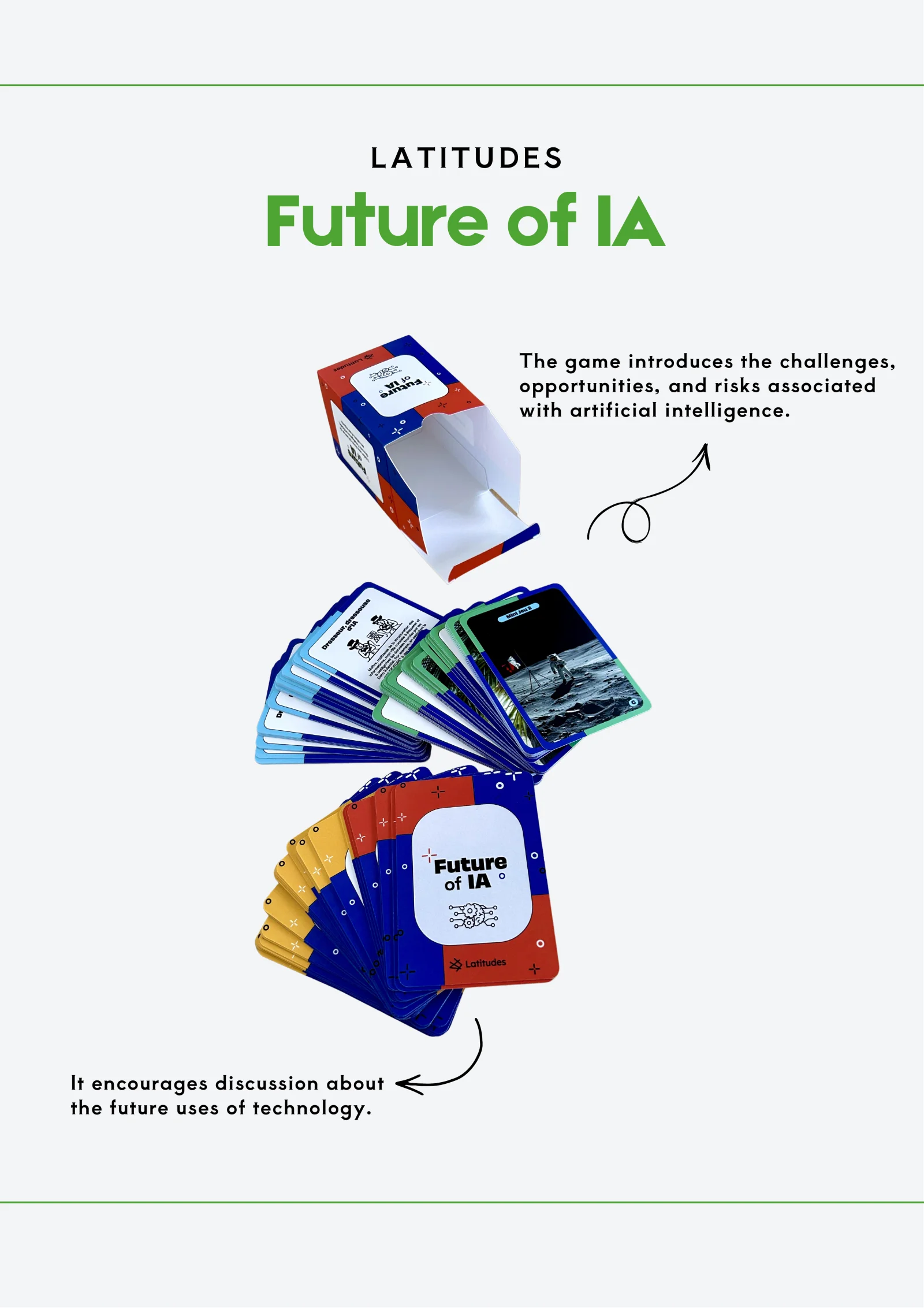
Future of AI has been designed to produce a precise effect on players. Introduces the stakes, opportunities and risks of artificial intelligence. Encourages debate on future uses of technology. Beyond this functional description, three pedagogical mechanics structure the experience.
First, a decision-based learning loop : at each turn, players are faced with choices whose consequences are revealed on the next turn. This loop forces situational thinking rather than abstract memorisation. Second, a progressive narrative : the first games are accessible to newcomers, but additional depth emerges in the second or third game, which allows the game to keep living within the organisation beyond the first session.
Third, a collective dimension by design. The game isn't built to be played alone but in teams of 3 to 8 people, which turns individual learning into a collective conversation. From the feedback measured by Latitudes, this collective dimension explains most of the 30-day retention gain compared with an equivalent e-learning format.
Manufacturing: technical choices and certifications
The production of Future of AI mobilised our French workshops to precise standards. On materials: 350gsm certified responsible-paper board for the box, Bristol 310gsm with black core for the cards (FFB standard), matte lamination for premium tactile feel, plant-based inks without COV ADEME high levels. On compliance: EN71-1 (mechanical safety), EN71-2 (flammability) and EN71-3 (chemical safety) tests carried out by an independent laboratory.
Production lead time was held to 6 weeks: 2 weeks of mockup and proof validation, 3 weeks of offset manufacturing, 1 week of finishing (lamination, foiling, cellophane wrapping) and packaging. This on-time delivery is the French norm: there's nothing exceptional about it. Compared with Asian sourcing which would have meant 12 to 14 weeks with a risk margin of several extra weeks, French sourcing allowed Latitudes to stick to its event calendar without any hitches.
The project is also documented on the auditable CSR side: numbered responsible-paper certificate for the paper, certificate Imprim'Vert for the print works, costed carbon footprint per unit, two-tier material traceability (learn more about our specialist game printer). This documentation becomes essential for public-sector buyers and large corporates subject to CSRD directive.
Results observed at Latitudes
Three success indicators were tracked during the rollout of Future of AI. First indicator: the actual usage rate. On equivalent projects we support, the B2B game is used by 70 to 85% of recipients within 6 months of distribution, a figure 5 to 6 times higher than the usage rate of an equivalent e-learning module.
Second indicator: the 30-day retention. Available studies (notably those reported by theADEME on environmental awareness programmes) show a retention gap of +40 to +60 points for a game format versus an asynchronous module format. On this case study, the measured gap was within that range.
Third indicator: the spontaneous social sharingThe game comes out at a team meeting, on lunch break, sometimes even in the collaborators' homes (depending on the format). This organic sharing generates a prolonged exhibition on the topic without any additional marketing costs. On Future of IA, the internal word of mouth generated a request for redeployment not anticipated 8 months after the initial launch.
Beyond the numbers, what sets this case apart is the durability of the programme. Where a digital campaign has a life expectancy of a few weeks, the game remains active for 24 to 36 months on desks and in departments. This average usage duration is the strongest economic argument for a serious B2B programme.
Have a custom game project?
Design, manufacturing, delivery turnkey. Detailed quote within 48 hours, free and no commitment.
Request a quote in 48hThe pitfalls we avoided on this project
Three classic traps were avoided on the deployment of Future of IA through precise framing upstream. Pitfall #1: under-sizing the initial print run. On projects of this nature, the temptation is to print 100 or 200 copies to "test", except that the economic price breaks in board games sit above 300 units. An initial run of 100 copies multiplies the unit cost by 3 to 4 with no quality gain. On this case, the initial run was calibrated at the right price break from the brief stage.
Pitfall #2: handing the mockup to a creative agency without a technical contact. A mockup that looks great on screen is not a printable mockup. Technical pitfalls (sRGB vs CMJNcolour space, lines too thin, missing bleeds, fonts not vectorised) generate costly back-and-forth between the agency and the manufacturer. On this project, our team pre-press was involved from the mockup phase, which avoided 2 to 3 weeks of downstream back-and-forth.
Pitfall #3: forgetting distribution logistics. For a project deployed across multiple sites (typical of large organisations), boxing, logistical labelling and multi-site delivery can account for 10 to 15% of the total quote. On this case, the logistics line was costed in the initial quote, which avoided any unpleasant surprise on the final invoice.
Do you carry out a project similar to Future of IA for Latitudes? We design and manufacture in the EU with EN71 compliance, plant inks and responsible paper certifications.
Request a quote